The Spelling Struggle Is Real
Part 1/10
Have you ever felt that English spelling was designed to confuse you?
You’re not alone.
For many children—and adults—English feels like a collection of random words where every new spelling seems to break the previous rule. One word says ea like bread, another says ea like team, while ough appears to have a personality crisis of its own!
It can be frustrating, overwhelming, and often leads learners to believe they are simply “bad at spelling.”
The truth is far more encouraging.
English spelling isn’t random. It is highly systematic.
Most spelling struggles happen because learners are taught isolated words instead of the logical system behind the language. Once you understand that system, English becomes much easier to read, spell, and teach.
This is exactly the approach I teach through Homeschooling with Hira, where we move beyond memorisation and uncover the logic hidden inside English.
The 26-42-75 Ratio: The Real Mathematics of English
If you truly want to master English spelling, stop memorising thousands of individual words and start understanding the mathematics behind them.
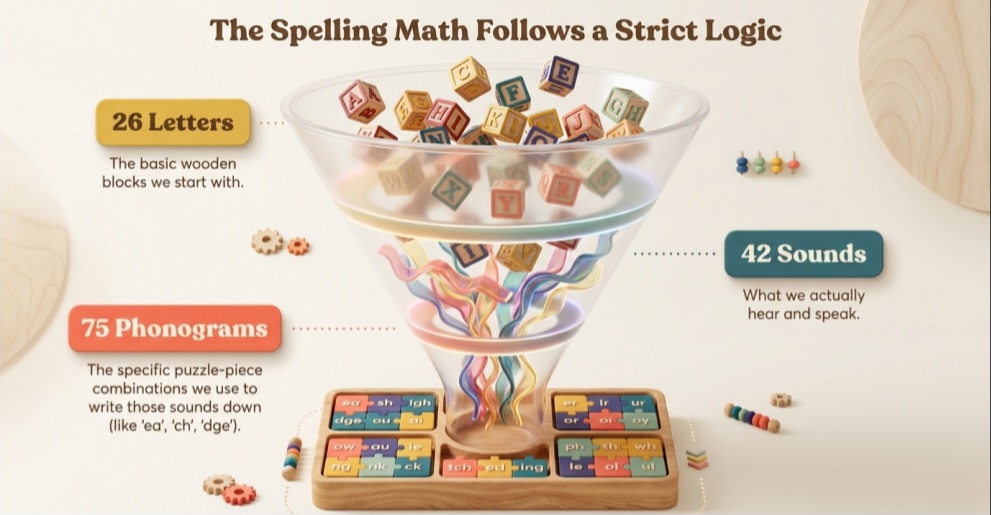
Everything begins with what I call the 26-42-75 Ratio.
- 26 letters make up the English alphabet.
- Those letters produce approximately 42 speech sounds (phonemes).
- Those 42 sounds are represented by around 75 common phonograms.
This is where most learners become confused.
A phonogram is simply a letter or group of letters that represents a sound.
For example, the long /ee/ sound can be written in several different ways:
- e — me
- ee — tree
- ea — tea
- ey — key
- y — pony
At first glance, this may seem complicated.
However, once these spelling patterns are taught in a logical sequence, English suddenly starts making sense.
Instead of asking children to memorise thousands of spellings, we teach them the patterns that create those spellings.
That is exactly why systematic synthetic phonics is so effective.
If you’d like to explore these spelling patterns in much greater depth, my book English Spelling Rules – A Logical Guide to Teach Spelling to Kids explains the logic behind English spelling step by step.
Once your child has mastered the 42 sounds, Spelling Stories with Mr Peanut – Part 1 introduces alternative spellings through engaging stories, while Spelling Stories with Mr Peanut – Part 2 teaches advanced spelling concepts, including syllables and more complex spelling rules.
The “OUGH” Mystery Isn’t Actually a Mystery
Few letter combinations frighten learners more than ough.
It seems completely unpredictable.
Consider these words:
- thought → aw
- though → oh
- through → oo
- bough → ow
- rough → uff
- thorough → uh
- cough → off
No wonder children think English has no logic.
But here’s the secret.
Instead of treating o-u-g-h as four separate letters, think of ough as one phonogram with several possible pronunciations.
Once children learn those pronunciation patterns, guessing disappears and confidence grows.
They are no longer memorising random spellings.
They are recognising patterns.
The Hidden Law of Syllables: Every Syllable Needs a Written Vowel
Understanding syllables transforms spelling.
A syllable contains one vowel sound.
However, English spelling follows another important principle that many programmes never teach.
Every syllable must contain a written vowel.
This explains many so-called “silent letters.”
Take words like:
- table
- little
- syllable
The final e in table isn’t there because we pronounce it.
It’s there because the final syllable needs a written vowel to exist.
Without that written vowel, the spelling would break the structure of English.
Once children understand this concept, many confusing spellings suddenly become logical.
To give your child extra practice, you can download my free phonics, spelling, and syllable worksheets here.
Stop Clapping Syllables—Use Your Body Instead
Many classrooms still teach children to clap syllables.
Although well-intentioned, clapping can be misleading because children often clap to the rhythm rather than to vowel sounds.
Instead, try these two multisensory techniques.
1. The Humming Method
Place your hand gently on your throat and hum the word.
Each distinct vibration represents one syllable.
For example:
- otter → 2 vibrations
- automatic → 4 vibrations
2. The Chin-Drop Method
Place your fist beneath your chin.
As you say the word, your chin naturally drops every time your mouth opens to produce a vowel sound.
Count the chin drops.
You’ll have the exact number of syllables.
These techniques provide physical feedback and are far more reliable than clapping, especially for young learners.
The Short “I” Trap
One of the most common pronunciation mistakes involves the short i sound.
Many learners accidentally pronounce it like:
- ee
- eh
This leads to spelling mistakes during dictation because children simply cannot hear the correct vowel sound.
A simple way to teach the distinction is by comparing these anchor words:
- At → short a
- Edge → short e
- In → short i
Now stretch the word slowly.
Instead of saying:
in
Say:
iiiiii-n
Slowing the word down helps children isolate the vowel sound and recognise the true short i.
This tiny adjustment often makes a huge difference in spelling accuracy.
English Isn’t Random—It’s Logical
When learners move from memorising words to understanding phonograms, everything changes.
Instead of seeing thousands of exceptions, they begin recognising predictable spelling patterns.
English becomes less about memory and more about understanding.
That shift builds confidence, improves reading, strengthens spelling, and makes teaching far more enjoyable.
The next time you come across a word that seems “irregular,” ask yourself:
Is it really irregular—or have I simply not been taught the phonogram behind it?
Once you master the 42 sounds, the 75 phonograms, and the structure that holds English together, spelling becomes far less intimidating.
As I often tell my students:
“Master these sounds, understand the patterns, and English will become a piece of cake.”
If you’re a parent, teacher, or homeschooler who prefers learning visually, I regularly publish free phonics, spelling, grammar, and teaching videos on my Homeschooling with Hira YouTube channel
There, you’ll find practical demonstrations, classroom examples, and step-by-step lessons to help you teach English with confidence.
Continue Learning
Continue your spelling journey with these carefully designed resources from Homeschooling with Hira:
- Spelling Rules Free Workshop
- English Spelling Rules – A Logical Guide to Teach Spelling to Kids
- Spelling Stories with Mr Peanut – Part 1
- Spelling Stories with Mr Peanut – Part 2
- Free Phonics, Spelling and Syllable Worksheets (Free)
- Homeschooling with Hira YouTube Channel (Free)
- Shop All Resources