5 Long Vowel Spelling Rules Every Parent and Teacher Should Know
Why English Spelling Isn’t as Random as You Think
If you’ve ever watched a child confidently spell rain but then write plai instead of play, you’re not alone.
Long vowel spellings are one of the biggest stumbling blocks for children learning English. One sound can often be represented by several different spellings, leaving many parents and teachers wondering whether English spelling is simply random.
Fortunately, it isn’t.
Behind what appears to be a confusing collection of exceptions lies a surprisingly logical system. Once children understand why certain spellings are used in different positions, they stop guessing and begin making informed choices.
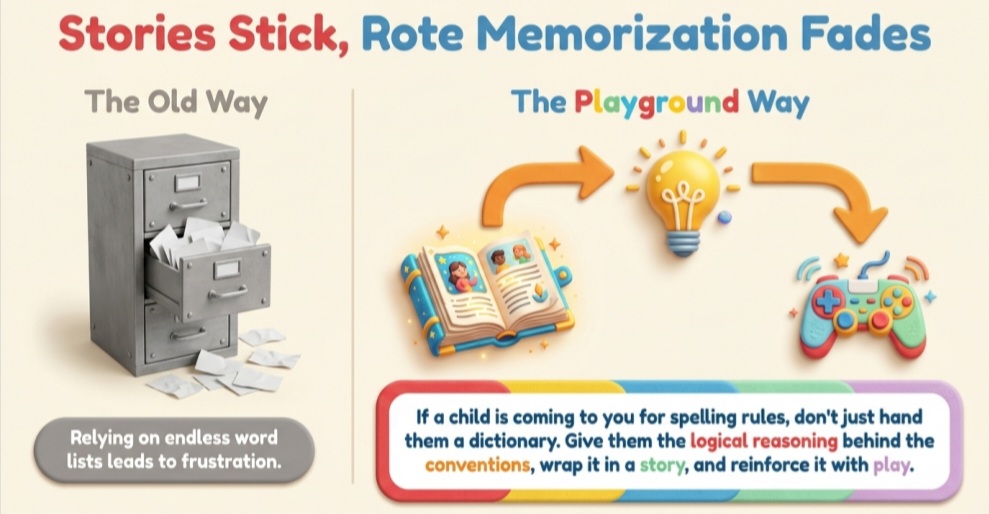
Rather than asking children to memorise endless spelling lists, we can teach them the hidden logic behind English. Stories, patterns, and multisensory techniques make spelling far easier to understand—and far easier to remember.
In this article, we’ll explore five long vowel spelling rules that I regularly teach in my classrooms and workshops. These simple ideas have helped countless children become more confident readers and spellers, and they can do the same for your child or students.
Whether you’re a parent supporting learning at home or a teacher searching for more effective ways to teach spelling, these practical strategies will help you move beyond memorisation and discover the remarkable logic hidden within the English language.
📚 About This Series
This article is Part 2 of the English Spelling Workshop Series by Homeschooling with Hira.
The series is adapted from my YouTube lessons, where I teach the hidden logic behind English spelling using memorable stories, systematic phonics, and multisensory teaching techniques. Instead of asking children to memorise thousands of words, I help them understand the patterns that make English spelling predictable and enjoyable.
Missed Part 1?
Before reading this article, I recommend starting with “The 26-42-75 Ratio: The Secret Math Behind English Spelling.” In that article, we explored why English follows logical spelling patterns rather than random memorisation and introduced the 42 sounds and 75 phonograms that form the foundation of English spelling.
If you’d like to watch these concepts being taught step by step, visit the Homeschooling with Hira YouTube Channel, where you’ll find practical lessons, classroom demonstrations, and free teaching tips for parents, teachers, and homeschoolers.
If you’d like to explore these spelling patterns in greater depth, my book English Spelling Rules – A Logical Guide to Teach Spelling to Kids explains the logic behind English spelling in a simple, systematic way and provides a strong foundation before introducing more advanced spelling concepts.
1. The “Shy I and Toughy Y” Rule: Why English Words Rarely End in I
Have you ever noticed that words like my, cry, fly, and try all end with the letter Y, even though they make the long I sound?
That isn’t a coincidence.
It’s one of the many logical patterns that make English spelling far more predictable than most people realise.
Traditionally, English words do not like ending with the letters I, U, V, or J. So whenever the long I sound appears at the end of a word, the letter Y steps in to do the job.
When I teach this concept, I don’t simply give children another rule to memorise. Instead, I tell them a story.
“Little I is very shy. He doesn’t like standing at the end of English words, so whenever he reaches the end, his best friend Y comes to help him.”
Children rarely forget stories.
Suddenly, words like my, by, cry, and dry begin to make perfect sense.
This simple story also helps children understand one of the biggest spelling choices they’ll ever make.
Compare these words:
Middle of the word
- rain
- train
- snail
- paint
- boil
- coin
- point
End of the word
- day
- play
- stay
- boy
- toy
- joy
Notice the pattern?
When the sound appears in the middle, English usually prefers AI or OI.
When the sound appears at the end, English usually chooses AY or OY.
Once children recognise this position rule, they stop guessing.
They begin spelling with confidence because they understand the logic behind the letters.
This storytelling approach is exactly why I created Spelling Stories with Mr Peanut. Instead of memorising isolated spelling rules, children remember memorable characters and stories that stay with them long after the lesson has finished.
2. The “EA” Long A Mystery: There Are Only a Handful of Words to Learn
One of the biggest myths about English spelling is that there are endless exceptions.
In reality, many “exceptions” belong to very small groups.
Take the vowel team EA.
Most of the time, children correctly learn that EA says the long E sound.
For example:
- eat
- sea
- read
- teacher
- leaf
However, every now and then, they come across words like:
- break
- great
- steak
Suddenly, everything seems confusing.
But here’s the good news.
There aren’t hundreds of these words.
There are only a small number of common words where EA makes the long A sound.
Some of the most important ones include:
- break
- great
- steak
- bear
- pear
- wear
- swear
- tear (to rip)
- yea
Instead of worrying about these words, treat them as a small family.
I often encourage children to create funny sentences using several of them together.
For example:
The bear didn’t wear his new shirt because he might tear it while eating a juicy pear.
The sillier the sentence, the easier it is to remember.
Instead of thinking,
“English has too many exceptions.”
Children begin thinking,
“Oh yes… these belong to the EA family.”
That small shift completely changes their attitude towards spelling.
3. Stop Guessing Between EE and EA
If I asked ten children to spell the word teacher, at least a few would probably write:
teecher
Can you blame them?
Both EE and EA make exactly the same sound.
So how do children know which spelling to choose?
Rather than encouraging random guessing, I prefer teaching words in meaningful groups.
Our brains remember ideas much better than isolated spellings.
For example, I group many EA words into categories.
Food Words
Think about words you can eat.
- pea
- peach
- beans
- meat
Water Words
Think about water or places connected with water.
- sea
- beach
- tea
School Words
These are words children use almost every day.
- read
- teacher
- teach
- reading
Instead of remembering individual spellings, children remember an entire category.
This makes retrieval much easier because they aren’t searching through hundreds of spellings.
They’re simply asking,
“Is this one of my food words?”
or
“Is this one of my classroom words?”
Teaching spelling through meaningful categories is far more powerful than teaching random weekly spelling lists.
To help reinforce these spelling patterns, download my free phonics, spelling, and syllable worksheets, where children can practice these vowel teams through engaging activities.
4. The “Magic I” Rule-Breakers: The French Connection
Just when children think they’ve figured out the long I sound, English throws them another surprise.
Consider these words:
- machine
- magazine
- marine
- routine
- vaccine
- quarantine
- trampoline
- tangerine
Many children naturally expect the letter I to make its usual long I sound.
Instead, it says /ee/.
At first, this looks like another frustrating exception.
But once again, there’s a logical explanation.
Many of these words entered English from French, where the letter I is commonly pronounced as the long E sound.
Instead of teaching these words as random exceptions, teach them as a French family.
Suddenly, children realise they aren’t breaking the rules at all—they’re simply following a different language’s spelling pattern.
This small piece of background knowledge helps children remember these words much more easily because they now have a reason behind the spelling.
One of the biggest lessons I try to teach is this:
Children remember reasons far better than they remember rules.
Whenever we can explain why a spelling exists, we reduce the amount of memorisation needed.
5. The Golden Nugget: Why English Words Rarely End in U
Here’s one of my favourite spelling rules to teach because it instantly removes hundreds of spelling guesses.
English words almost never end with the letter U.
Think about it.
How many words can you name that actually finish with U?
There are only a handful, such as you and thou, and even those are uncommon in everyday spelling.
So what happens when a word finishes with the /yoo/ or /oo/ sound?
English uses alternative spellings instead.
For example:
The /yoo/ sound
- value
- rescue
- continue
- argue
- new
- few
The /oo/ sound
- blue
- glue
- clue
- true
- grew
- chew
Instead of ending with U, these words finish with combinations like UE or EW.
This is what I call a Golden Nugget.
It’s a simple rule that immediately helps children eliminate incorrect spellings.
When they are unsure whether a word should end with U, they already know the answer.
It almost certainly won’t.
Little pieces of logic like this save children from making hundreds of unnecessary spelling mistakes over time.
English Isn’t Random—It’s Remarkably Logical
The biggest transformation I see in children isn’t just better spelling.
It’s a change in mindset.
At the beginning, many children believe that English spelling is impossible.
They think success depends on having a “good memory.”
But once they begin discovering patterns, stories, and logical explanations, something changes.
Instead of asking,
“How am I supposed to remember this?”
they begin asking,
“What’s the pattern here?”
That single shift changes everything.
English spelling stops feeling like a collection of random exceptions and starts revealing itself as a beautifully organised system.
Yes, there are unusual words.
Yes, there are historical influences.
But the overwhelming majority of English follows consistent spelling patterns that can be taught, understood, and remembered.
As I often remind my students,
“Don’t memorise the word. Understand the pattern.”
Once children learn to think this way, spelling becomes easier, reading becomes more fluent, and their confidence grows naturally.
So, the next time you come across a word that seems strange, don’t assume English is being difficult.
Ask yourself:
“What logic have I not discovered yet?”
You may be surprised by how often there’s an answer.
Continue Learning
Ready to continue your spelling journey?
Here are some carefully designed resources to help children become confident readers and spellers.
English Spelling Rules – A Logical Guide to Teach Spelling to Kids
Discover the hidden logic behind English spelling through clear explanations, practical examples, and a systematic approach that helps children spell with confidence instead of memorising endless word lists.
Spelling Stories with Mr Peanut – Part 1
Learn alternative spellings through engaging stories that children remember long after the lesson ends.
Spelling Stories with Mr Peanut – Part 2
Continue the journey with advanced spelling patterns, syllables, and more complex spelling rules.
Free Phonics, Spelling and Syllable Worksheets
Download printable worksheets to reinforce these spelling patterns at home or in the classroom.
Homeschooling with Hira YouTube Channel
Watch the complete English Spelling Workshop Series along with hundreds of free lessons on phonics, spelling, grammar, and creative writing.
Explore More Resources
Browse our growing collection of books, teaching resources, and educational materials designed to make English simple, logical, and enjoyable.