
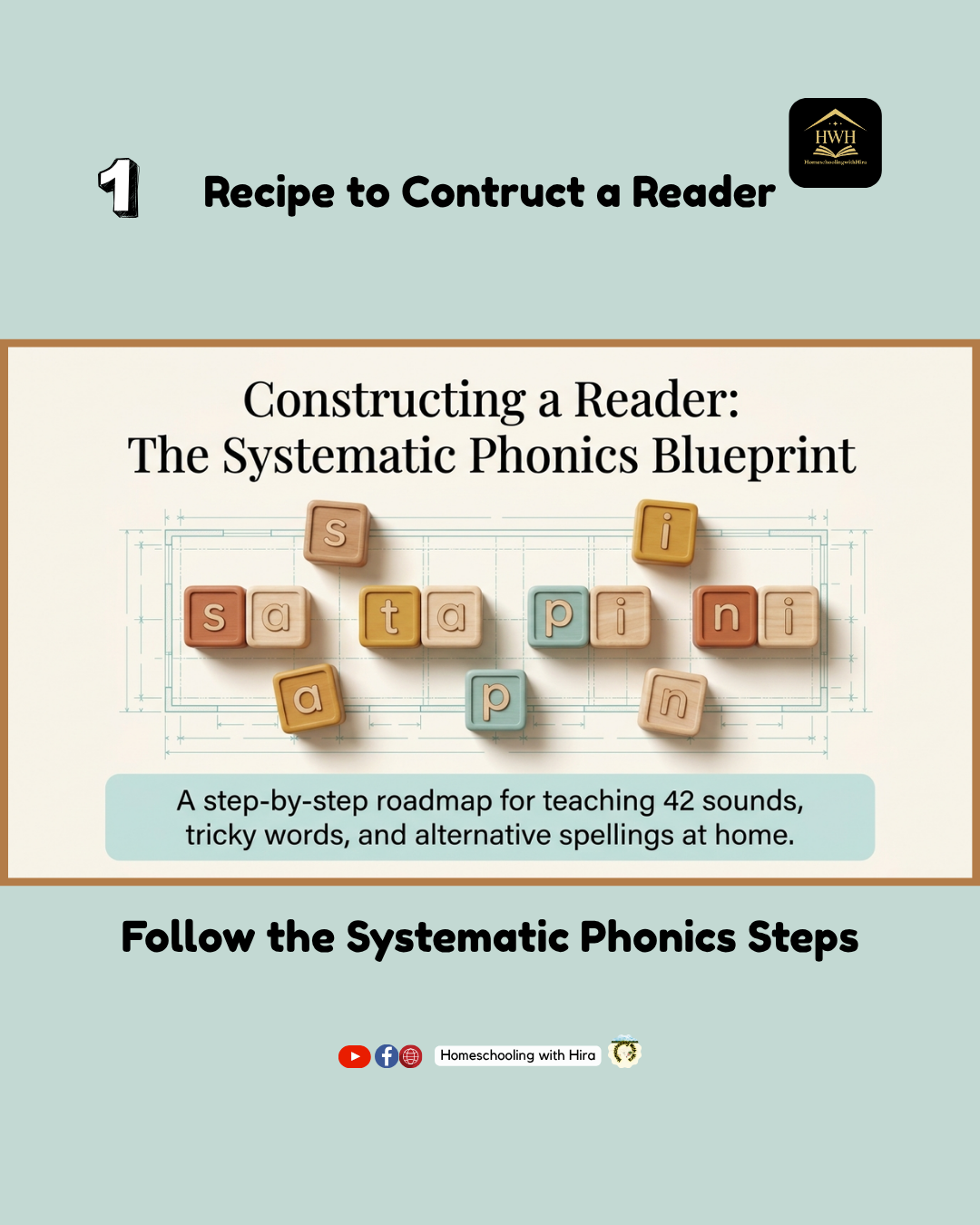
Cracking the Reading Code: A Systematic 3-Step Roadmap to Teaching Phonics at Home
1. Introduction: The “Where Do I Start?” Dilemma
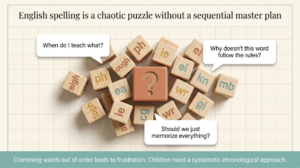
Teaching a child to read is one of the most rewarding yet daunting tasks a parent can undertake. Many parents find themselves paralysed by two fundamental questions: When do I teach? and What do I teach? It often seems mysterious why some children pick up reading effortlessly while others struggle. As a literacy specialist, I can tell you the secret isn’t found in a child’s natural ability alone, but in applying a systematic framework rather than a random approach. This post distils a professional educator’s roadmap into actionable steps to help you navigate the journey from first sounds to fluent stories.
2. Takeaway 1: It’s 42 Sounds, Not Just 26
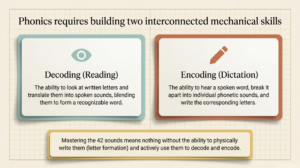
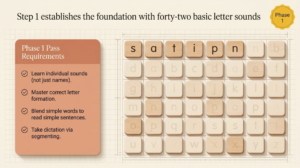
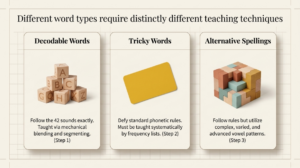
The first pillar of a systematic phonics program is moving beyond the standard 26 letters of the alphabet. To truly master the English code, children must learn the 42 basic letter sounds used in the Jolly Phonics framework.
However, teaching these sounds involves more than just a quick recital. To follow the “proper way,” you must treat each sound as a separate, deep-dive lesson. Rather than a fast-paced flashcard drill, each sound requires dedicated focus to ensure the child can recognise it both in isolation and within words.
Crucially, this is also the stage where you must integrate correct letter formation. As an educational consultant, I emphasise that handwriting and phonics are not separate subjects; they are two sides of the same coin. Teaching a child how to physically write the letter while they learn its sound anchors that knowledge in their long-term memory.
Reflection: Why start with 42 sounds instead of 26 letters? By teaching digraphs (two letters that make one sound, like sh or th) from the beginning, you provide the child with a comprehensive toolkit. This allows them to decode a vast majority of words in early readers, building momentum and logic-based confidence before they ever encounter “tricky” exceptions.
3. Takeaway 2: Blending and Segmenting—The “Reading Muscles”
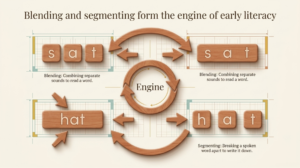
As children learn individual sounds, they must develop two vital “reading muscles”: blending and segmenting.
Blending is the ability to push individual sounds together to read a word. For example, a child sees s-a-t and blends them to say “sat.”
Segmenting is the reverse. It involves breaking a spoken word into its individual sounds to write it down. For the word “hat,” the child identifies the sounds as /h/, then /a/, then /t/.
I tell parents to view these as the two sides of a single coin. While blending leads to reading, segmenting is the absolute key to independent writing.
“This is the first step, and this is the foundation of your children. Begin from here and spend some time to make them perfect in all these sounds and how to blend and segment them.”
4. Takeaway 3: The Bridge to Big Words—Consonant Blends
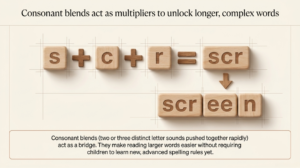
Once children can handle simple three-letter words, they encounter consonant blends. These are groups of consonants in which each letter retains its own sound, such as s-c-r in “screen.”
These blends act as a necessary bridge from “CVC” (consonant-vowel-consonant) words to complex vocabulary. The systematic way to teach these is to move from three-letter blends (like scr or spl) to two-letter blends (like bl, cl, or fl). By showing children how to isolate and decode each sound within these clusters, you prevent them from feeling overwhelmed by longer words. They realise that “screen” isn’t a scary new obstacle; it’s just a series of sounds they already know.
5. Takeaway 4: Mastering “Tricky Words” Without the Cramming
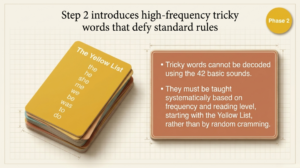
The second major step is introducing Tricky Words. These are high-frequency words that do not follow standard phonetic rules at this stage (e.g., “the” or “was”).
To teach these effectively, do not resort to “cramming” or rote memorisation. Instead, use a tiered approach. Start with the Jolly Phonics “Yellow List,” which contains the most frequent tricky words for beginners. Use multisensory activities—visual aids, tactile writing, or games—to make these words stick. The goal is recognition through familiarity, not the stress of a spelling bee.
6. Takeaway 5: The “One Sound, Many Faces” Rule (Alternative Spellings)
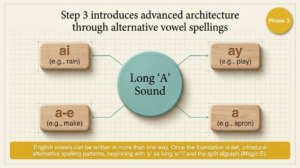
Step three introduces alternative vowel spellings. This is the concept that a single vowel sound can be written in multiple ways (e.g., the long “a” sound in rain, play, and gate).
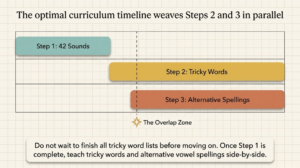
This stage should be introduced alongside your tricky word lists, not after they are all finished. Using a systematic chart to track these alternatives is essential.
Reflection: This is often the point where English feels “tricky”, and children may lose confidence. As a specialist, I advocate using a visual chart as a logic map. When a child sees that a sound has “many faces,” it transforms a confusing obstacle into a predictable pattern, helping them maintain their self-assurance as they tackle advanced texts.
7. Takeaway 6: The “Secret” Spelling Rules Every Parent Needs
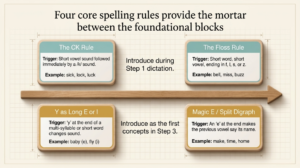
To assist with dictation and writing, children should be taught four basic spelling rules concurrently with the 42 sounds:
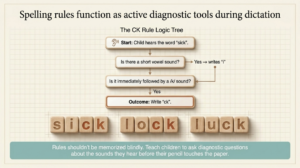
The CK Rule: Use ck only after a short vowel sound (e.g., sick, lock).
The Floss Rule: If a one-syllable word has a short vowel and ends in f, l, s, or z, you double that final letter (e.g., cliff, bell, miss, jazz).
The ‘Y’ as a Vowel: Teaching that ‘y’ often acts as a long e or long i at the end of words.
The Magic E (Split Digraph): Teaching how a silent e at the end “kicks” the preceding vowel to make it say its name (e.g., hop becomes hope).
These rules provide the “why” behind the spelling, giving children a sense of mastery over the language.
8. Conclusion: From Sounds to Stories
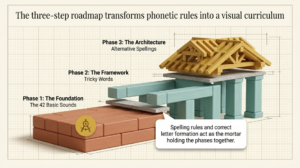
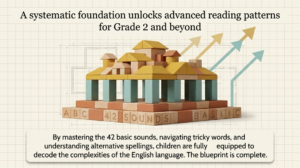
The journey from sounds to stories follows a clear, logical path: master the 42 sounds and letter formation, navigate Tricky Words, and finally, decode Alternative Spellings. By following this systematic framework, you provide your child with a stable structure for lifelong literacy.
To take action today, you can access free resources—including worksheets and PDF guides for the 42 sounds, the Yellow List, and the spelling rules mentioned here. These tools are the final piece of the puzzle to help you implement this roadmap immediately.
Now that you have the roadmap, which of these steps will you implement during your next reading session?


Üsküdar Uygun Fiyatlı Su Kaçağı Tespiti
June 1, 2026Üsküdar Uygun Fiyatlı Su Kaçağı Tespiti Duvar içi tesisat kaçağını kırmadan tespit ettiler. https://www.millenniumscale.com/
homesschoolingwithhira
June 16, 2026Hi there, thank you for your query. Yes, you can, but keep the pace faster. Also, watch my spelling rules playlist (available for free) on my YouTube channel for advanced phonics.
Mbachun
June 11, 2026Please I will like to know if I can use same method to teach an adult ( my cousin) she is 25years old